GST 2.0 Is Live: India's New Tax Chapter Unfolds Today
India officially embarked on a new chapter of its taxation journey today. As GST 2.0 is launched, the nation has made one of its most ambitious moves towards streamlining taxation since the inaugural Goods and Services Tax (GST) was implemented in 2017.
Where GST 1.0 was unifying the nation on the concept of "One Nation, One Tax," GST 2.0 is simplifying that system, making it more pragmatic, and more user-friendly. The reforms commenced on 22 September 2025, and their effects will be felt in households, enterprises, and the economy at large beginning from today.
In this article, we deconstruct all that you need to know why these changes were necessary, what actually has changed, how it impacts consumers and businesses, and what this implies for India's future economy.
WATCH THIS : https://www.youtube.com/watch?v=TbZVCAMz1Cw
Why GST Needed an Overhaul
The introduction of GST in 2017 was a game-changer. It consolidated a messy cluster of state and central taxes — excise, VAT, service tax, octroi, entry tax — into a single, unified framework. Yet, as time went on, there were a number of challenges which were evident:
Too many slabs: The existence of multiple tax rates (0%, 5%, 12%, 18%, 28%) and special cesses introduced unnecessary complication.
Classification disagreements: Companies and courts battled for years over whether a product was to be taxed at 12% or 18%.
Overwhelming compliance burden: Returning, reconciling bills, and keeping current with endless notifications overwhelmed particularly small businesses.
Disconnect between consumers: Consumers tended to have a problem with knowing why two comparable products were taxed differently.
It emerged that while GST had brought together taxation, it had not yet reached the point of simplicity. GST 2.0 aimed to address these loopholes.
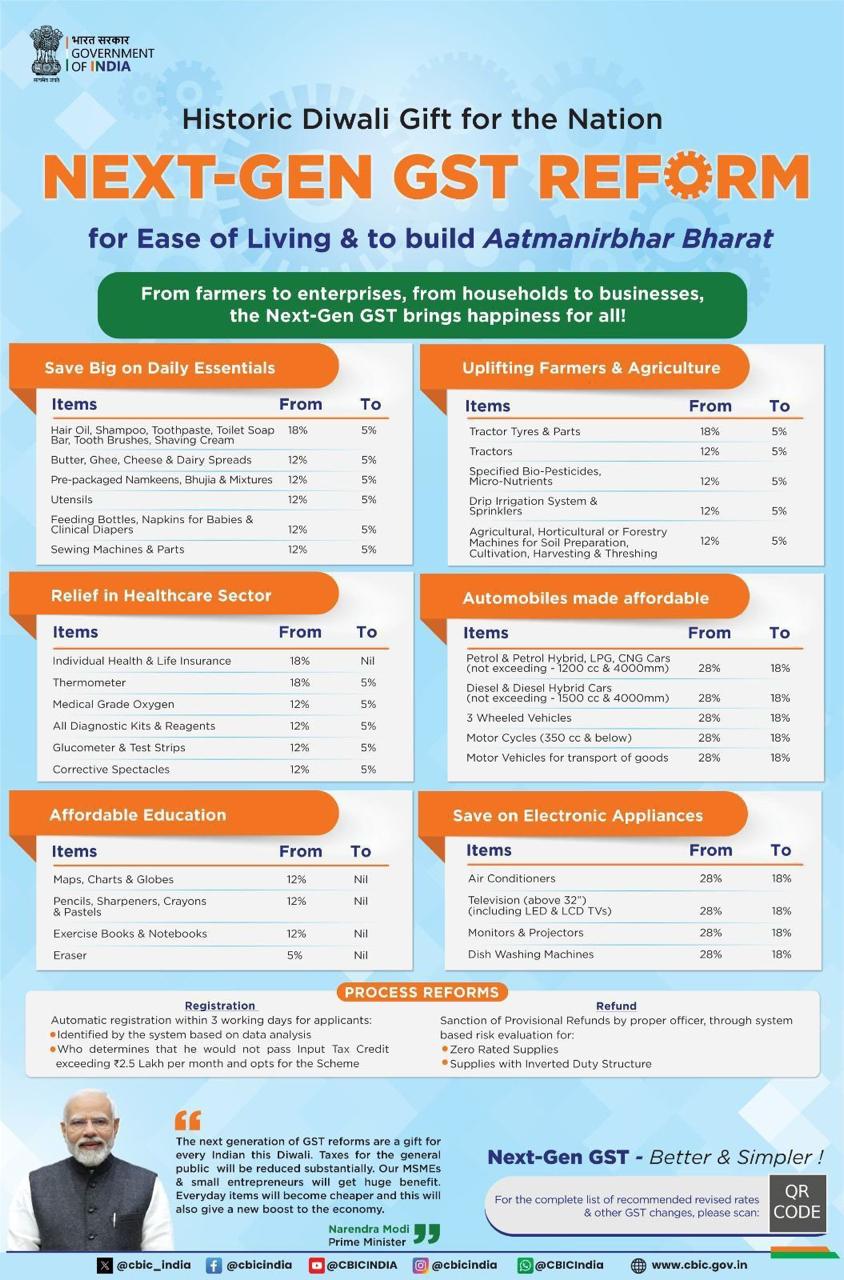
The Central Shift: GST Slab Structure Reorganisation
The core of GST 2.0 is its rationalized slab system.
5% Slab → Commonly used items of daily consumption and goods of mass usage.
18% Slab → Standard rate for general goods and services.
40% Slab → A new introduced "sin and luxury tax" category for high-end cars, cigarettes, and aerated drinks.
By shrinking the system down to only two principal slabs and one special class, the government has made a giant leap towards simplification, lower disputes, and easy compliance.
What Gets Cheaper: Relief for the Common Man
One of the grandest assurances of GST 2.0 is to ease the tax burden on essentials. These are the categories where the consumer will feel the pinch:
Food and Groceries: Milk, paneer, ghee, biscuits, cereals, dry fruits, and condiments have been shifted to lower slabs or exempted. This directly reduces monthly household spending.
Healthcare and Insurance: Medicines, diagnostic tests, health insurance, and life insurance premiums now face lower GST, reducing the cost of healthcare.
Electronics and Appliances: TVs, washing machines, fridges, and other such appliances are now in lower slabs, providing festive-season relief.
Automobiles (non-luxury): Two-wheelers and small cars now face lower GST, reducing middle-class mobility expenses.
To the common household, this means substantial savings on day-to-day spending.
What Gets More Expensive: Luxury Pays More
To offset these tax cuts, GST 2.0 adds a 40% slab for sin and luxury items.
Luxury Cars: Luxury cars and SUVs now pay much more GST.
High-Value Clothing: Designer wear and clothing over ₹2,500 are taxed more.
Sin Items: Tobacco products, alcohol alternatives, and aerated drinks with sugar pay higher taxes to increase revenue as well as deter use.
The message is loud and clear: basics are insulated, luxury takes a hit.
Impact on Businesses
GST 2.0 isn't simply about consumers; firms are among the largest gainers:
Streamlined Compliance: Fewer slabs mean easier invoicing and return filing, thus lowering compliance costs.
Less Litigation: Smaller slab categories translate to fewer classification disputes, which have jammed courts and GST tribunals in the past.
Demand Boost: With consumers saving more on necessities, discretionary spending on goods is likely to increase, thus benefiting retail, manufacturing, and services.
MSME Relief: Small and medium enterprises can now manage compliance with ease, leaving them free to concentrate on growth and not paperwork.
This reform is especially important to India's MSME sector, which contributes almost 30% of GDP and employs millions.
Why the Timing Matters
Implementing GST 2.0 just ahead of the festive season — with Navratri, Dussehra, and Diwali just around the corner — is a masterstroke. Families will be splurging on groceries, appliances, cars, and insurance over the next few weeks, and reduced GST on these essentials means instant relief at the billing counter.
Meanwhile, the government is marketing GST 2.0 as a "GST Savings Festival," associating it with policy as well as consumer feeling.
Likely Challenges
No reform is without challenges. While GST 2.0 is implemented, some challenges will have to be navigated:
Shifting Benefits to Consumers: Manufacturers and retailers need to be watched so that they pass tax reductions in end prices, rather than taking them in terms of additional margin.
Old Stock Pricing: Already existing goods with pre-reform MRPs would take some time to reflect lower prices.
Luxury Sector Pushback: High-end industries selling high-value goods would grumble about repressed demand owing to the high 40% slab.
Revenue Balancing: With big tax reductions on essentials, the government will need to balance luxury and sin taxes to compensate for prospective revenue losses.
Bigger Economic Picture
GST 2.0 is more than consumer prices or business receipts. It has greater economic significance:
Managing Inflation: Reduced taxation on essentials protects households from inflationary shocks.
Domestic Demand Boost: Subsidized essentials and appliances translate into greater disposable income, driving consumption-led growth.
Investment Environment: A simpler, more predictable tax environment makes India a more attractive investor economy.
Equity in Taxation: By taxing luxury more and essentials less, GST 2.0 is a progressive thinking — taxing according to social justice.
What Shall Consumers and Businesses Do Now?
For Consumers:
Check your bills — ensure the new GST rates are applied in your purchases.
Shop for major purchases like electronics and cars now, since the reduced slabs will save you a lot of money.
Monitor your monthly expense — you should notice actual savings, particularly on food, healthcare, and insurance.
For Companies:
Incorporate billing and accounting systems at once to prevent mistakes.
Train employees to follow new slabs.
Convey benefits to customers in a timely manner to create trust and goodwill.
Utilize this streamlining to reduce compliance expense and invest in expansion.
Conclusion: A Step Towards Simpler, Fairer Taxation
GST 2.0 is not just a tax overhaul — it is a reboot of India's philosophy of indirect taxation. It streamlines the system, lessens the burden on the basics, and hands more buying power to common citizens.
Yes, luxury will be more expensive, and yes, companies will have to change fast. But the advantages of ease, equity, and price control are much greater than the difficulty.
The actual success of GST 2.0 will ride on the effectiveness of how well businesses and retailers adopt it and the speed at which customers feel the benefits. Well-implemented, GST 2.0 might be the day India's taxation system finally does what it promised in 2017: become simple, transparent, and helpful to citizens and businesses alike.
From now on, your shopping cart should be cheaper, your medicines should cost less, and your home budget should go further. That is the promise of GST 2.0 — and it is one that millions of Indians will be eagerly waiting for.
At BillClap, we’ll continue to track GST 2.0 — from sector-specific impacts to compliance tips. Follow our blog for insights, updates, and tools that make your GST journey smoother.